
Crypto & Markets
SpaceX's IPO Just ‘Entered’ Crypto: Tokenized Stocks, Perpetuals, and What They Mean
The biggest IPO of all time didn't stay inside Nasdaq. Within hours, SpaceX stock (SPCX) already had tokenized versions, perpetual futures with billions in volume, and cancelled pre-IPO campaigns on crypto exchanges due to... a shortage of shares. Here's what actually happened, how these products work, and what risks sit behind the hype.
What Happened in 30 Seconds
- SpaceX (SPCX) IPO'd on Nasdaq on June 12, priced at $135 and closed at $160.95 (+19.2%).
- The IPO raised ~$75B, with a valuation above $2T — the largest IPO in history.
- Binance recorded over $5.6B in daily SPCXUSDT perpetuals volume — its #2 product after Bitcoin.
- Binance, Bybit and Bitget cancelled tokenized pre-IPO programs due to a shortage of available shares — with full refunds.
- Tokenized stocks (e.g. bStocks) ≠ perpetual futures: one represents an actual share in custody, the other is a contract on price.
- Bitcoin traded around $63–64K with a mild recovery, while liquidity briefly rotated toward the SpaceX trade.
1) The IPO itself: a record in size
On June 12, SpaceX made its Nasdaq debut under the ticker SPCX. The IPO price was set at $135, the stock opened at $150 (+11%) and closed its first day at $160.95 (+19.2%), reaching as high as $176 intraday. Total valuation topped $2 trillion, with the IPO raising roughly $75 billion — the largest in history, ahead of Saudi Aramco. The offering was oversubscribed 4x.
2) Why it matters for crypto: the xAI connection
In early 2026, SpaceX acquired xAI, bringing with it the Grok AI models and X (formerly Twitter). That turns SPCX into something like a proxy for the broader AI narrative — which is why crypto-native investors and AI-linked altcoins (Worldcoin, NEAR, Bittensor, etc.) reacted to news around the IPO, as we covered in our earlier altcoin exit checklist article.
3) Tokenized stocks: what a ‘bStock’ actually is
Binance launched ‘bStocks’ — tokens that, according to the company, are backed 1:1 by real shares held in custody by a regulated custodian. A tokenized SPCXB would correspond to one actual SPCX share. Users can convert between traditional shares (via the broker-dealer Nest Trading) and tokenized bStocks 1:1, with no conversion fee. Each token is a certificate of exposure to the underlying share — not a separate security issued by the exchange itself.
4) Perpetual futures: the ‘twin’ product with a different risk profile
Alongside tokenized stocks, many exchanges offered SPCX perpetual futures — contracts on price, with no expiry, representing no actual share ownership. On Binance, the SPCXUSDT perpetual became the platform's #2 most active product (after Bitcoin perpetuals), with over $5.6 billion in daily volume and $167 million in open interest. On Hyperliquid, the equivalent pre-IPO perpetual had traded as high as 35% above the IPO price ($183), before ‘landing’ near the actual opening price once the stock began trading on Nasdaq — a textbook example of how far a speculative perpetual can drift from ‘real’ price before that price officially exists.
The risk that surfaced: a shortage of shares
The most interesting part wasn't the success — it was the failure: Binance Wallet, Bybit, and Bitget Wallet cancelled their pre-IPO tokenized programs (SPCXx), citing ‘circumstances outside their control’ — in essence, they couldn't secure enough real shares to back the tokens they had already sold. Binance Wallet's campaign alone had raised $557 million from nearly 28,000 wallets. All users received full refunds, but the episode makes one thing clear: ‘tokenized’ doesn't always mean ‘guaranteed’ exposure — it depends entirely on whether the issuer can actually acquire the underlying asset.
6) What this means for you
If you see ‘tokenized SPCX’ or ‘SPCX perpetual’ on an exchange, the first question isn't ‘how much did it go up’, but ‘what exactly do I own?’ A bStock backed by a real share in custody has a different risk profile than a perpetual that simply ‘tracks’ a price — and both differ fundamentally from owning the share through a traditional broker.
Second, the cancellation of the SPCXx programs is a live example of ‘liquidity & supply’ risk — exactly the kind of point we covered in the altcoin exit checklist: when demand vastly outpaces the available supply of an asset (even a tokenized one), something has to ‘break’ — and usually it's the promise that breaks first, not the price.
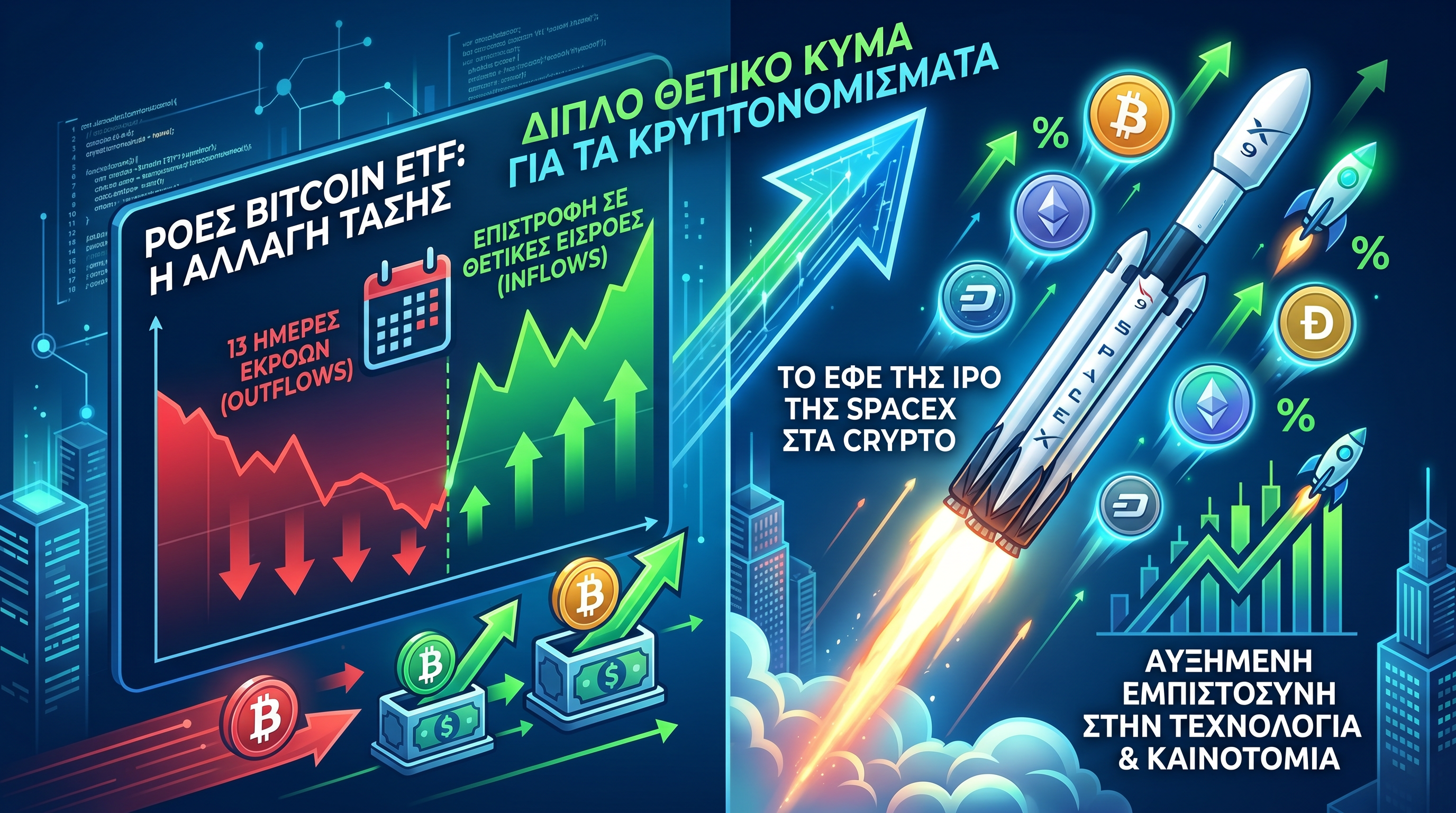
Finally, in the broader crypto context, this week saw Bitcoin make a mild recovery toward $63–64K, with ETF flows turning positive after the record outflow streak we covered in our previous article. The SpaceX IPO seems to have temporarily absorbed some liquidity and attention — another reminder that crypto doesn't move in a vacuum, but reacts to what's happening in ‘traditional’ markets too.
Frequently Asked Questions (FAQ)
What is a ‘tokenized stock’ (e.g. a bStock)?
It's a token that represents exposure to a real share. In Binance's bStocks, each token is backed 1:1 by an actual share held in custody by a regulated custodian, and is issued by an affiliate entity with regulatory approval.
What's the difference between a tokenized stock and a perpetual future?
A tokenized stock corresponds to a real share in custody — you have (indirect) exposure to the asset itself. A perpetual future is a contract on price, with no expiry and no ownership represented — it simply ‘tracks’ price via an oracle/funding rate. Different risks: custody/counterparty risk on the former, funding/liquidation risk on the latter.
Why did Binance, Bybit and Bitget cancel their tokenized SPCX programs?
They cited ‘circumstances outside their control’ — in practice, they couldn't secure enough real SPCX shares to back the tokens already sold in pre-IPO campaigns. They issued full refunds plus extra compensation (e.g. airdrops, gas vouchers).
Why was the Hyperliquid SPCX perpetual trading 35% above the IPO price before the listing?
Before the stock officially listed, the ‘pre-IPO perpetual’ was based on market expectations/estimates of the eventual valuation — not on actual trading prices. Once the stock opened on Nasdaq, the contract ‘landed’ near the real opening price, showing how far a speculative derivative can drift from reality before that reality exists.
What does SpaceX's IPO have to do with altcoins?
SpaceX acquired xAI in 2026, so it functions as a kind of proxy for the AI narrative. Many AI-linked altcoins reacted to news around the IPO. Additionally, the overall attention and liquidity absorbed by the SpaceX trade can temporarily ‘drain’ capital from other crypto assets — something worth factoring into the macro context of your positions.